The Shocking Connection Between Jura and Kawaki
Boruto Two Blue Vortex Chapter 27 Spoiler
The first official spoiler for Boruto Two Blue Vortex Chapter 27 has literally blown up the fandom. But not because someone died, or because Himawari unleashed a new power. The spotlight this time is on Jura and what we’ve seen completely forces us to rethink everything we thought we knew about this being.
Today, I’m not just going to break down this spoiler. I’m going to use it as the final key to unlock one of the deepest mysteries in the entire story—the one connecting Jura and Kawaki. Get ready, because after this analysis, you’ll see Kawaki and the entire future of the shinobi world in a completely new way.
The Deceptively Mundane Spoiler Panel
Now, let’s dive into the most fascinating parts. The official Boruto manga panel that leaked online is confusingly mundane at first glance. Just a heads-up—I can’t actually show the manga panel itself in the article, but I’ll use exact art that captures the scene perfectly.
The image shows Jura, a being powerful enough to wipe out an entire village by himself, just sitting in a café in Konoha. Jura is calmly eating dango and drinking tea. He isn’t fighting, he isn’t searching for his target, and he isn’t spreading fear or chaos. He’s simply relaxing like a tourist exploring local traditions.
This single scene is the perfect embodiment of the phrase: “Those who possess true power have no need to fear.” He’s sitting right in enemy territory, just a few steps away from his target, Himawari, and yet he acts as if the whole world is his personal comfort zone.
Shikamaru’s Unprecedented Order
But the true horror lies below, in the second half of the scan, where we see a short conversation between Shikamaru and Inojin. Inojin asks, “You’re serious?” and Shikamaru replies, “I told the sensory unit to keep reporting on him just in case, but for now, there’s nothing we can do except leave him alone. I’ve also ordered the police not to intervene.”
And this is where things start to get really interesting. Let’s pause for a moment and grasp the full depth of that order. The acting Eighth Hokage—the leader of the greatest shinobi village in history—is openly admitting total and unconditional defeat. He’s giving a direct order not just to avoid attacking, but to not even approach an enemy who’s freely walking through their home.
This is something absolutely unprecedented in Konoha’s history. During Pain’s invasion, the village fought until the very end. During the Fourth Great Ninja War, every nation united against a common enemy. But now? Konoha’s strategy is literally to stand still and hope that the monster gets full on dango and leaves by himself.
This isn’t just a tactical decision—it’s a sentence passed on the entire current shinobi system. Shikamaru, the genius strategist, understands perfectly well that any attempt to attack Jura will only lead to pointless casualties. They no longer have Naruto or Sasuke, warriors powerful enough to confront a threat of that level. Kawaki? He’s strong, but his own power isn’t enough—he can’t handle this alone. Himawari? She’s pure potential, but right now, she’s still a child and worse, she’s the main target.
Shikamaru is trapped. He can’t protect the village through force, but he can’t allow it to be destroyed in a hopeless battle either. His order isn’t an act of authority—it’s an act of desperation, a last-ditch effort to buy a little time they don’t actually have.
Why Doesn’t Jura Attack?
Now, some fans might say this feels like weak writing—similar to what we saw in the Pain arc. Why does the villain, with every opportunity to reach their goal, suddenly decide not to? Why doesn’t Jura just go straight for Himawari?
But I believe this isn’t weakness at all—it’s the most important clue to understanding Jura’s nature. His inactivity, his curiosity, his calm walk through Konoha—this isn’t hesitation. It’s learning.
The Kawaki Connection
And that leads us to the second, main part of our analysis. And this is where things truly begin to get fascinating. This strange behavior of Jura didn’t appear out of nowhere. Doesn’t he remind you of someone?
Think back to Kawaki when he first arrived at the Uzumaki household. He was wild, distrusting, traumatized—a child who had known nothing but pain and combat training. And suddenly, he’s in a world filled with warmth, family, kindness, and the small, human joys of everyday life.
Remember his reaction to taiyaki? To a vase with flowers? To a simple family dinner? He didn’t understand that world—he was studying it. Quietly observing, absorbing everything, trying to make sense of family life, of the normal rhythm of the Uzumaki household and the entire village.
Now look at Jura. He’s a newborn consciousness in a godlike body. He emerged from the Ten Tails’ cocoon, driven by primitive instinct and an endless curiosity. And what does he do upon entering Konoha? Exactly what Kawaki once did. He studies. He tries local food, he watches people, he observes peace itself—before carrying out his ultimate mission.
His walk through Konoha isn’t idleness—it’s field research. He’s doing what Kawaki did, but on a cosmic level. Kawaki tried to learn what it meant to be human within a family. Jura is trying to learn what it means to be human within a civilization he intends to consume.
Four Key Evidence Points
And that behavioral parallel is just the tip of the iceberg. Let me break down every piece of evidence showing that Jura isn’t just a clone—he’s a distilled, primal reflection of Kawaki’s very soul.
1. Psychological Alignment
As it’s been established, every Shinju is instinctively drawn to the emotional core of its prototype. Hidari and his prototype, Sasuke, are both fixated on Sarada—for Sasuke, his daughter is his light and his hope. Matsuri and her prototype, Moegi, are both drawn to Konohamaru, connected through long-standing friendship and subtle romantic undertones.
Now let’s apply that rule to Jura. His main target is Naruto Uzumaki. And ask yourself this: who in the entire Naruto-Boruto universe is more deeply, more obsessively, and more pathologically attached to Naruto than Kawaki?
For a boy who never knew love, whose father sold him like an object, Naruto became everything—a father, a mentor, even a god. This obsession is the very core of Kawaki’s personality. His love is absolute, possessive, and self-consuming. He was willing to kill Boruto, his adoptive brother, just to “protect” Naruto. He sealed Naruto away in another dimension—condemning him to isolation, yet believing it was the only way to keep him safe.
Jura is the mirror of that obsession. His desire to consume Naruto isn’t just a hunger for Kurama’s power—it’s a philosophical hunger. He wants to understand the essence of love and the bonds that made Naruto great. Kawaki, unable to truly comprehend love, tries to protect its object through control and imprisonment. Jura, as his primal reflection, tries to grasp love by devouring its source.
2. Physical Resemblance and Visual Symbolism
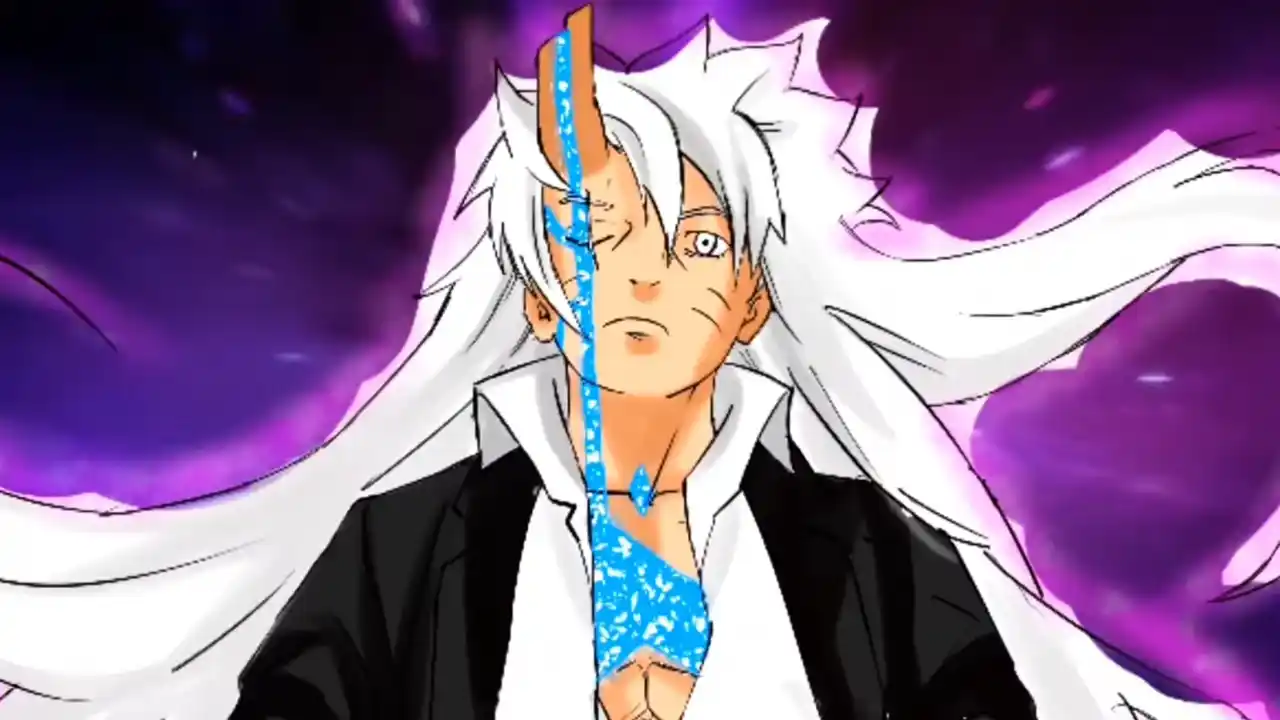
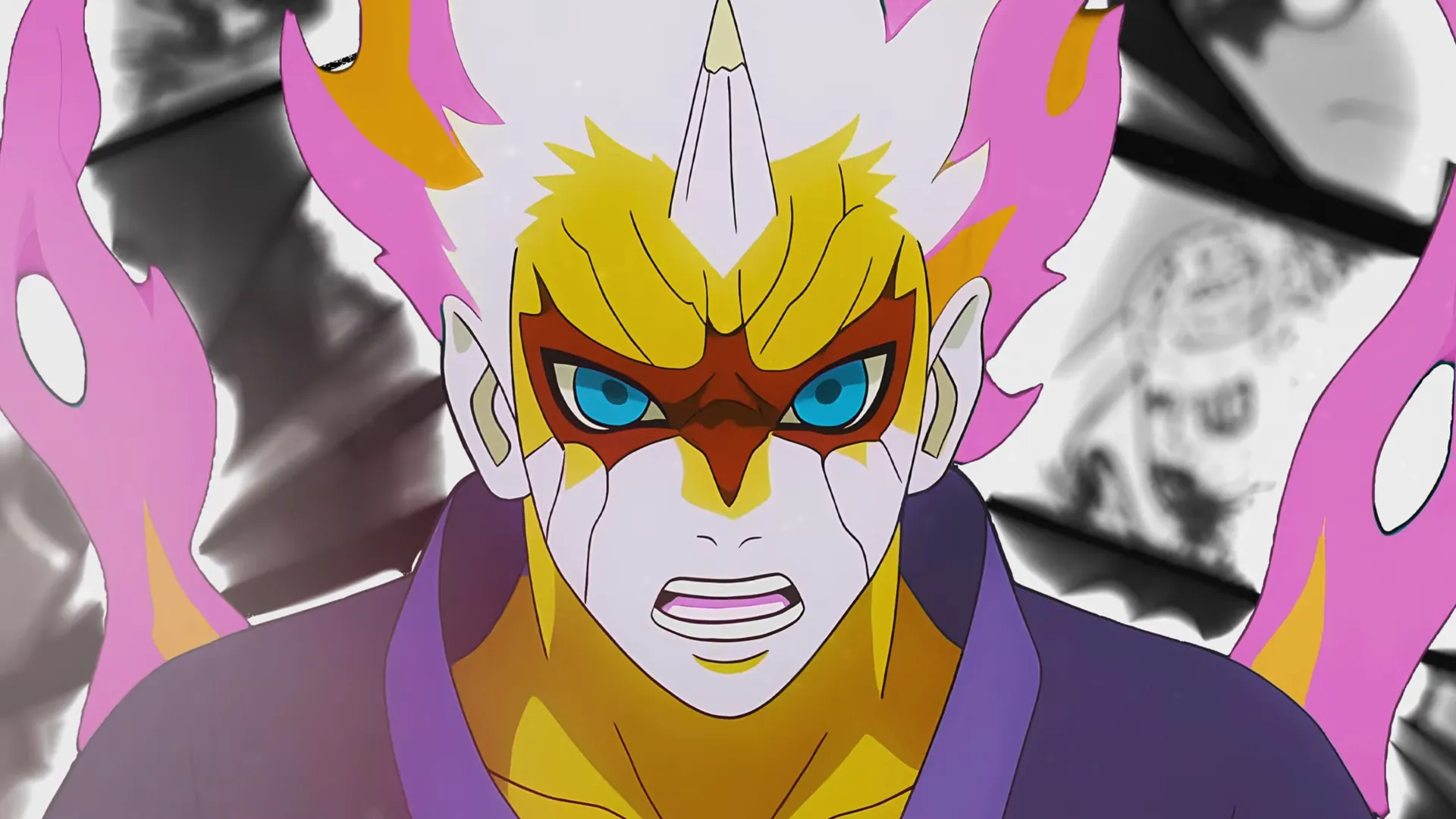
Just place Jura and Kawaki side by side—the resemblance is striking. The same haircut—shaved sides with a long fringe. The same body type. Even that same cocky smirk. Ikemoto doesn’t draw details by accident. On one of the official covers, we even saw Kawaki depicted in Jura’s color palette. That’s a direct artistic hint—Jura is Kawaki’s alter ego, the dark side of his own soul.
3. Unique Ability
Think about the other Shinju clones. Hidari uses Sasuke’s Chidori. Matsuri uses Moegi’s Wood Release. Each one inherits the signature technique of their original. Now look at Jura. His defining power is levitation. Flying is a rare ability—one that Kawaki inherited from Isshiki. If each Shinju clone inherits their prototype’s abilities, then logically, the only prototype for a flying Jura is Kawaki himself.
4. The Creation Mechanism
Yes, Kawaki is alive and well—he didn’t turn into a tree. So how could a clone of him exist? The answer lies in Kawaki’s unique biology. He isn’t an ordinary human. Thanks to Karma, he’s 80% Otsutsuki. That means the cloning process involving him was different—far more advanced and precise.
Now think back to the chaotic attack of the Clawed Beasts on Konoha. At one point, Kawaki was grabbed by one of them—but this one was different. It had a Rinnegan. That creature was a proto-Jura. The Rinnegan allows its user to absorb chakra. Most likely, during that brief contact, it didn’t bite Kawaki—it drained his chakra and, more importantly, copied his biological and spiritual data.
So why didn’t Kawaki turn into a tree? Because the Ten Tails recognized him as an Otsutsuki host and triggered a different cloning protocol. Instead of the crude transformation we saw with others, a delicate, parasitic data transfer took place. Proto-Jura absorbed Kawaki’s personality imprint, subconscious fears, desires, and most importantly, his obsessive attachment to Naruto.
It’s reminiscent of how White Zetsu could copy personalities through contact—but on a completely new, evolved level. That single moment of connection with Kawaki’s Otsutsuki-infused chakra became the catalyst that awakened the dormant Ten Tails and triggered its evolution into sentient Shinju beings.
The Terrifying Truth
When you piece all of this together, what we get is a terrifyingly coherent picture. Jura is Kawaki. Or rather, he is a distilled version of Kawaki—stripped of emotion, morality, and human restraint. He represents Kawaki’s desperate need to protect Naruto, twisted into a desire to consume him. He is Kawaki’s inability to comprehend love, transformed into a philosophical quest to understand it through destruction.
And this, right here, is the real tragedy. In his attempt to protect the light Naruto gave him, Kawaki unintentionally created the darkness now trying to devour that very same light. It’s the classic story of the road to hell paved with good intentions.
Jura isn’t just some external villain to be defeated—he’s a living reminder of what hides deep within Kawaki’s soul. And maybe, to truly defeat Jura, Kawaki will have to face not a monster—but himself.
That dango-eating panel isn’t a filler scene or comedic moment—it’s a chilling echo of Kawaki’s past and the key to understanding the future of the entire shinobi world. Read more Boruto Manga theories and manga breakdowns on our site.